
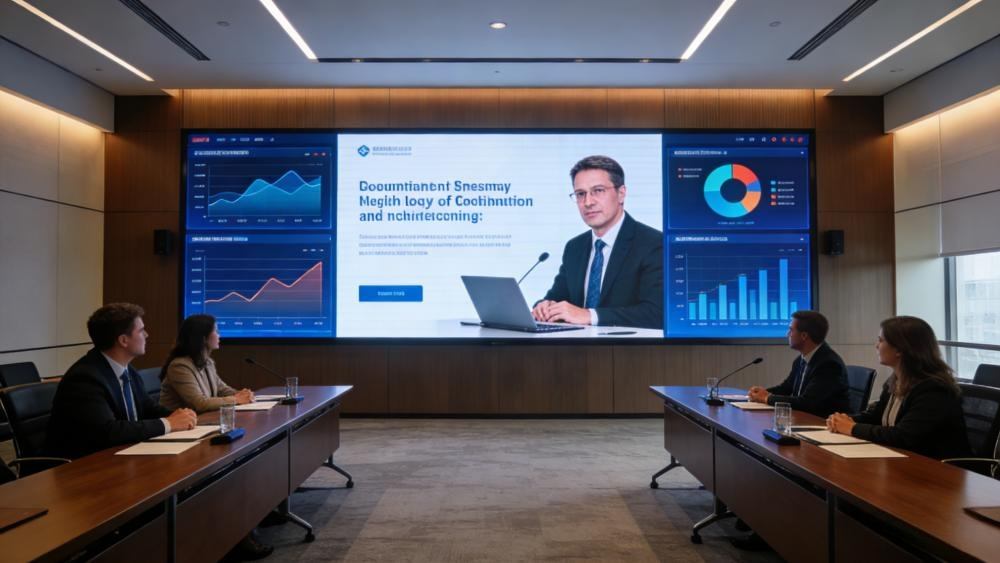
Indoor Small Pixel Pitch LED Display P0.9 vs P0.7 | Technology, Applications & Selection Guide
/Indoor Small Pixel Pitch LED Display technology has become the cornerstone of today’s high-end visual communication environments. From executive boardrooms and command centers to broadcast studios and premium digital exhibitions, ultra-fine pixel pitch LED displays are rapidly replacing traditional LCD video walls and projection systems.
As pixel pitch continues to shrink, P0.9 and P0.7 LED displays have emerged as the two most discussed specifications in the ultra-high-end market. However, choosing between them is not simply about “smaller is better.” It is a strategic decision involving viewing distance, image fidelity, cost structure, and long-term value—especially for CONFERENCE Room LED Display Solution projects.
This in-depth guide will help you clearly understand the technical differences, visual performance, application scenarios, cost implications, and future trends of P0.9 vs P0.7 indoor small pixel pitch LED displays—so you can make a confident, professional decision.
1. Why Compare P0.9 and P0.7 Indoor Small Pixel Pitch LED Displays?
Indoor small pixel pitch LED displays have become the standard for premium indoor visualization, driven by three major industry trends:
- Increasing demand for seamless large-format displays
- Growing need for 4K / 8K ultra-HD content
- Higher expectations for immersive, fatigue-free viewing
Among all available specifications, P0.9 and P0.7 represent the cutting edge of indoor LED display technology.
- P0.9 is widely regarded as the current commercial sweet spot, offering excellent clarity with relatively mature manufacturing.
- P0.7 pushes the boundaries of display precision, often associated with COB technology and ultra-high-end installations.
Understanding their differences is critical when designing a Conference Room LED Display Solution, where clarity, reliability, and professional image matter most.
2. Core Concepts Explained: Pixel Pitch & Pixel Density
2.1 What Is Pixel Pitch?
Pixel pitch (measured in millimeters) refers to the distance between the centers of two adjacent LED pixels.
- Smaller pitch = tighter pixel arrangement
- Smaller pitch = higher image precision at close viewing distances
2.2 Pixel Density Comparison
Pixel density directly affects physical resolution and image detail.
| Model | Pixel Pitch | Pixel Density (approx.) |
|---|---|---|
| P0.9 | 0.9 mm | ~1,234,567 pixels/m² |
| P0.7 | 0.7 mm | ~2,040,816 pixels/m² |
This means a P0.7 indoor small pixel pitch LED display contains over 65% more pixels per square meter than P0.9—an important factor for ultra-close viewing and micro-detail rendering.
3. Deep Technical Comparison: P0.9 vs P0.7
3.1 Pixel Pitch & Density Impact
Higher density allows:
- Sharper text
- More legible spreadsheets
- Better rendering of CAD drawings, data dashboards, and fine UI elements
3.2 Packaging Technology: SMD vs COB
SMD (Surface-Mounted Device)
- Mature, cost-effective, widely used
- Practical lower limit around P0.9
- Easier point repair
COB (Chip on Board)
- Chips mounted directly onto PCB
- Dominant solution for P0.7 and smaller
Advantages:
- Higher reliability
- Better surface flatness
- Superior anti-collision & moisture resistance
For high-end conference room LED display solutions, COB-based P0.7 displays deliver outstanding long-term stability.
3.3 Other Key Parameters
- Refresh Rate: Both typically ≥3840Hz (P0.7 often higher)
- Gray Scale: Up to 16-bit for smoother gradients
- Brightness: 600–1000 nits adjustable for indoor comfort
- Power Consumption: Slightly higher for P0.7 due to pixel density, but intelligent power management minimizes differences
4. Visual Performance: The Ultimate Showdown
4.1 Clarity & Resolution
- P0.7 delivers visibly sharper images, especially under 3–5 meters
- Fine text and UI elements remain crisp even at extreme proximity
4.2 Color Accuracy & Uniformity
- Better color uniformity with COB encapsulation
- Less color shift across modules
- Improved white balance consistency
4.3 Contrast & Black Level
- Deeper blacks
- Higher native contrast
- More “paper-like” visuals
4.4 Grain-Free Viewing Experience
- P0.9 → minimal grain
- P0.7 → virtually invisible pixel structure
5. Application Scenarios: Where Each Model Excels
5.1 P0.9 Indoor Small Pixel Pitch LED Display Applications
- Corporate conference rooms
- Control rooms & monitoring centers
- Broadcast studios
- Financial trading floors
- Brand showrooms & lobbies
Ideal for most CONFERENCE Room LED Display Solution projects
5.2 P0.7 Indoor Small Pixel Pitch LED Display Applications
- Executive boardrooms
- National-level command centers
- XR virtual production studios
- High-end digital art exhibitions
- Private cinema installations
6. Cost & Investment Analysis
6.1 Why Costs Increase Exponentially
- More LED chips per square meter
- Lower manufacturing yield
- Advanced COB processes
- Higher calibration complexity
6.2 Price Comparison (Indicative)
P0.7: ~1.5–2× the cost of P0.9 (per m²)
6.3 Total Cost of Ownership (TCO)
| Cost Factor | P0.9 | P0.7 |
|---|---|---|
| Initial Investment | Lower | Higher |
| Maintenance | Moderate | Lower (COB) |
| Energy Efficiency | High | High |
| Lifespan | 100,000 hrs | 100,000 hrs |
7. How to Choose the Right Indoor Small Pixel Pitch LED Display
Decision Checklist
- Primary Use: Conference / Command / Broadcast?
- Viewing Distance: Front row distance?
- Content Resolution: 4K / 8K?
- Budget Ceiling: CapEx tolerance?
- Installation Environment: Lighting & space constraints?
Final Recommendation
Choose P0.9
Best balance of performance, reliability, and ROI for most professional environments.
Choose P0.7
When budget allows and absolute image perfection is required.
8. Market Trends: Which One Is the Future?
- P0.9 remains the mainstream choice with the highest shipment volume
- P0.7 represents the technological frontier
- COB & MIP technologies will gradually reduce cost barriers
- Long-term trend favors ultra-micro pitch LED displays
9. Key Innovations Driving Small Pixel Pitch LED Displays
- COB / MIP / IMD packaging
- Micro LED chips
- High-refresh low-power driver ICs
- Pixel-level calibration
- Integrated control systems
- Smart brightness & thermal management
10. Frequently Asked Questions (FAQ)
Q1: Can the human eye really see the difference between P0.7 and P0.9?
Yes—especially under 3 meters or with dense data content.
Q2: Is COB repair difficult?
Module-level replacement is common and reliable in professional projects.
Q3: For a 10m-deep conference room, which is better?
P0.9 is usually sufficient and more cost-effective.
Q4: LED lifespan differences?
Both exceed 100,000 hours with proper operation.
Q5: What parameters matter besides pixel pitch?
Refresh rate, gray scale, color uniformity, system reliability.
11. Conclusion: Finding the Perfect Balance
Choosing between P0.9 and P0.7 Indoor Small Pixel Pitch LED Displays is ultimately a balance between visual excellence and project investment.
- P0.9 delivers outstanding value and meets most high-end professional needs
- P0.7 defines the future of ultra-precision indoor display
Call to Action
If you are planning a CONFERENCE Room LED Display Solution, command center, or premium visualization project, Rigard LED is ready to help.
- Custom display design
- Viewing distance simulation
- Budget optimization
- On-site technical consultation
Rigard LED — Your Trusted Indoor Small Pixel Pitch LED Display Manufacturer.


